

Walking with the Ancients: Exploring the Hidden Mayan Sites of the Yucatán
Yucatán’s most magical ruins aren’t always the ones with the biggest Instagram crowd. For travellers who want whispers of stone, jungle, and history rather than selfie traffic jams, here are four exceptional Mayan ruins, far off the beaten path, but rich with stories, architecture, and raw presence. For anyone who only has a day or two to play with and have a hankering for the big sites, we’ll also dip into a few overlooked corners of Chichén Itzá as well. Pixel Expeditions invites you to walk with the ancients… with respect, curiosity, and care.
Why these Mayan sites matter (and why “hidden” is good)
Mainstream Mayan tourism often centers on Chichén Itzá, Tulum, or Palenque. But those are just the tip of a grand iceberg. The Maya world once spanned dense forests, lowlands, and hill country. Their sacred architecture adapted to local ecology, water supply, politics, and spiritual cosmologies.
Part of Pixel’s mission is sustainable tourism in Yucatán. We want to channel travellers toward sites that are less trafficked, for a few reasons. Firstly, so that visitor pressure doesn’t overwhelm sensitive ruins. The big names can get very busy! Secondly, travelling to lesser visited sites allows us to support conservation, local communities, and more authentic experiences.
In that spirit, we will journey to:
Xpuhil - a compact but architecturally curious site in the Río Bec zone
Calakmul - the grand jungle capital, any expedition’s crown
Uxmal - the Puuc jewel, often visited, but with still-hidden stories
Kabah - the quiet sibling down the Puuc route
We’ll also include a few things that people miss on the Chichén Itzá trail. So, without further ado, let’s walk.
Xpuhil (Xpujil): A charming introduction to Río Bec mystery
History & architecture
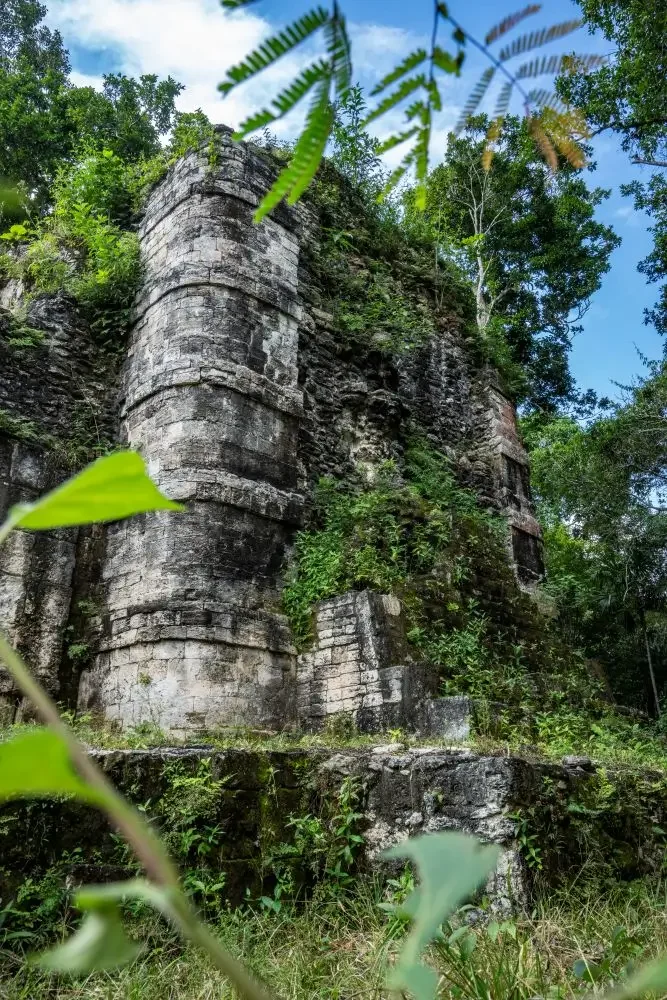
Xpuhil (often spelled Xpujil) lies in the state of Campeche, between Chetumal and Escárcega, near modern Xpujil town. The ‘X’ is pronounced as a short ‘sh’ and the name means “cat’s tail,” which refers to a local plant. Archaeological evidence suggests occupation somewhere from the Early Classic to the Late Classic periods, which means a period (that may surprise many) between 300–1200 AD. That said, the major structures are thought to date somewhere between 600–900 CE.
The site is part of the ‘Río Bec’ architectural tradition, which is known for playful, decorative facades, false towers (non-functional stairways), steep and narrow staircases, and facades with mosaic masks and geometric motifs. One standout, Structure I, features three towers (instead of the usual two), with a steep decorative staircase as well as nonfunctional doors and interior passages. The towers are too steep or fragile to fully climb; and one side allows limited access into a corridor that opens onto a partial roof platform.
There are 17 known construction groups at Xpuhil, that form courtyards, room blocks, and residential structures, with many still overgrown or partially excavated. Xpuhil’s style reflects both regional aesthetics and local adaptation. You wil see subtle mosaics, serpent motifs, and decorative stonework even on less prominent structures.
Visitor experience & highlights at Xpuhil
The full site is compact enough that most visitors can walk it within 1 hour. But, there’s no rush, and simply taking in the atmosphere is almost worth an hour by itself.
There is a stairway in the left tower allowing partial climb or peep out.
Depending on the time of year, falcons are known to nest in the central tower; you might catch them coming and going.
The main draw is Structure I / Group I, with its triple-tower form, mask decorations, and architectural curiosity.
Because Xpuhil lies near the junction of Campeche and Quintana Roo in the biosphere corridor, it makes a great “warm-up” stop en route to Calakmul or other ruins on our 7 Day Yucatán Adventure and 12 Day Ultimate Yucatán Expedition.
Visitor tip from Pixel: Walk the outer perimeter more than once. Sometimes a less-restored wall will show mosaic patterns or stucco reliefs the main routes miss. Pause under shade and listen: jungle sounds (birds, insects) feel more immediate here than at crowded big sites.
Calakmul: The great jungle capital
History & significance
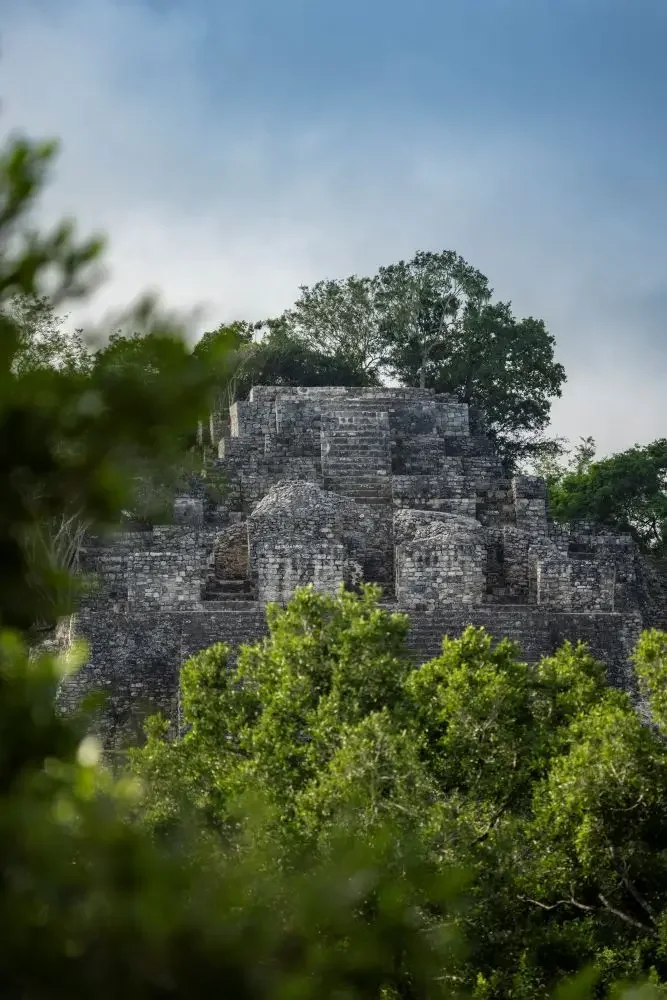
If Xpuhil is the charming appetiser, Calakmul is the banquet. Deep in the jungles of Campeche, Calakmul was a superpower in the Maya world, rivaling Tikal and other great capitals. Its modern name means ‘two adjacent mounds/pyramids’ while what is believed to be its ancient name, Uxte’tuun, means place of three stones.
Calakmul was the political center of the Kaan (Snake) dynasty, and engaged in deep dynastic rivalries (especially with Tikal) in the Late Classic period (c. 600–900 CE). And the site is big, with over 6,000 known structures, many of which remain unexcavated. These include dozens of plazas, temples, stelae, causeways (sacbeob), and residential zones. In fact, Calakmul holds the greatest number of stelae in the Maya world (with more than 100 identified), though many are badly eroded).
Intriguing murals have been discovered in some interior chambers (for example in the Chiik Naab group). They show not royal scenes but daily market life, food preparation, offerings, glyphs. Because much remains buried, exploring Calakmul is partly personal archaeological detective work.
Visitor experience & highlights at Calakmul
Visiting Calakmul is more of an expedition; it demands planning, a little extra stamina, and respect for the jungle. But it is completely worth it!
Structures I and II are pyramids that are among the highest climbable structures at Calakmul. The views above the canopy are unforgettable. And if heights are not your thing, then walk between stelae-lined plazas and try to find the glyphs.
Some causeways (or ‘sacbeobs’) radiate outward to neighboring terrain so you can walk short sections to imagine how the Maya moved across forest. In fact, one benefit of Calakmul is its forest context. You can expect to hear howler monkeys, see toucans, coatis, maybe peccaries and your Pixel guide will help you spot jungle life.
Visitor tip from Pixel: If you have time to yourself, start on the east side and walk looping trails so you don’t retrace your steps. Pause on pyramid steps and rotate slowly, letting the forest soundscape absorb you. Pausing on a ruined platform at the right time of day will offer shade and ambience few tourists in Yucatán enjoy.
Uxmal: The classic, elevated Puuc splendor
History & architecture
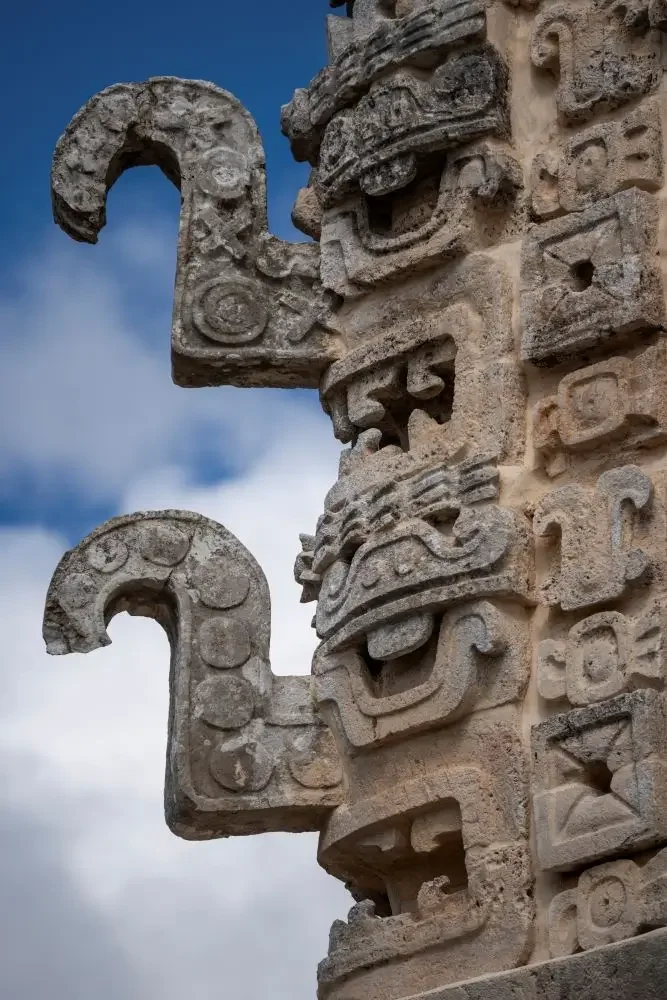
Uxmal was a major city in the Puuc zone, flourishing between around 600 and 900 AD, with building peaking in the Terminal Classic era. Its architectural style, known as Puuc style, features plain lower walls and richly decorated upper façades, intricate mosaic friezes, masks of the rain god Chaac, snake motifs, fretwork, and geometric relief. The name ( Óoxmáal in the original Yucatec, means either “three times built” or “what is to come”, depending on sources.
Celebrated buildings at Uxmal include:
Pyramid of the Magician (Pirámide del Adivino): It has a unique oval base, five terraces, steep staircases, decorative masks and reliefs.
Nunnery Quadrangle (Cuadrángulo de las Monjas): Four symmetrical buildings enclosing a central courtyard, richly decorated façades.
Governor’s Palace (Palacio del Gobernador): A long stretched façade platformed on a base, with over 400 Chaac masks embedded, and alignment significance with Venus.
El Palomar: Reopened relatively after renovation, this structure has delicate decorative elements and a restored cresting
Uxmal is also well-integrated with the Puuc Route (Ruta Puuc), and is connected by sacbe (white roads) to sites like Kabah, Sayil, Xlapak, Labná. Since the Puuc zone lacks cenotes, the Maya built chultunes, or cisterns, as well as water catchment systems. The Governor’s Palace area includes several chultunes and cisterns.
Visitor experience & hidden details
You should generally allow at least 2 or 3 hours to explore Uxmal thoroughly, but if a plan allows then Pixel Expeditions will aim for a full immersive experience. Sunrise or late afternoon light is especially dramatic on the façades.
Look out for subtle carvings of turtles (House of the Turtles), small masks in cornices, serpent motifs merging into friezes, these are often missed if you walk too fast. Also easy to miss is that the Governor’s Palace has alignment to Venus with the façade decoration including glyphs tied to Venus cycles.
Visitor tip from Pixel: Begin at the Magician’s Pyramid, then climb to its vantage points before descending into the Nunnery Quadrangle. Pause in doorways and quiet niches and look back, sometimes the carvings and shadow-play in reverse direction catch your eye better.
Kabah: Quiet elegance down the Puuc route
History & relationship to Uxmal
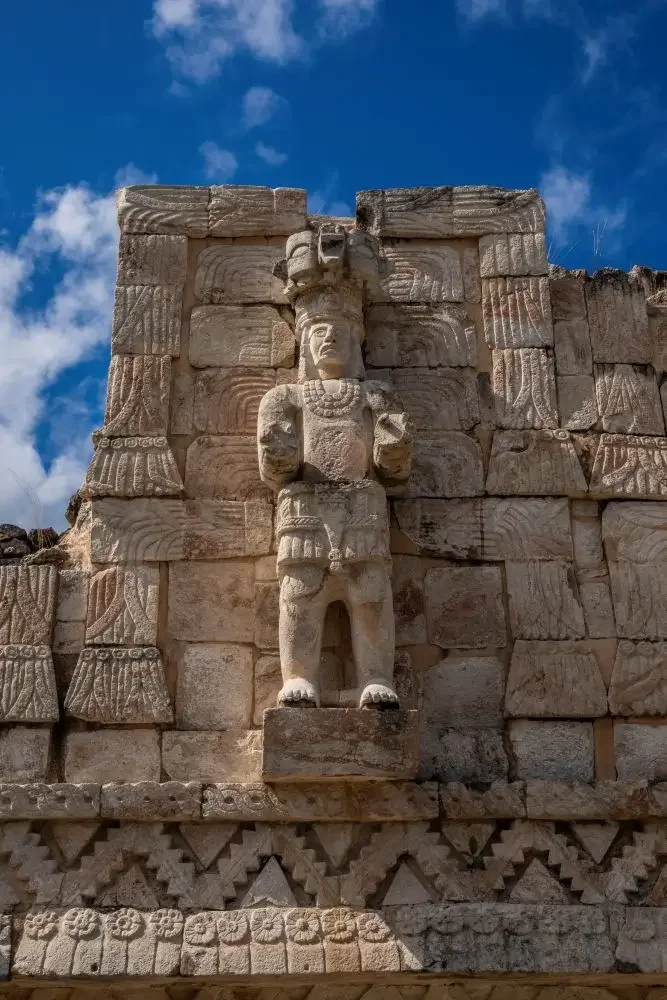
Kabah is one of Uxmal’s quieter siblings, lying around 18 km away and connected by a sacbe (raised road) lined with arches. Another site with different names depending on the source, Kabah is thought to mean “strong hand” (kab “hand” + ah “strong”). Similar to Uxmal, the architecture here is mostly from the Classic to Terminal Classic (600–1000 CE).
Kabah’s style is Puuc, with emphasis on carved stone panels, architectural mosaics, fretwork, and repeated Chaac masks. One of its standout structures is Codz Pop (also “Palace of the Masks”), which is a façade densely covered in stone mask motifs and delicate detailing. One thing that really stands out here is that because there are many structures spread along the highway on both sides, Kabah can feel less like a restored city and more like a city in fragments.
Visitor highlights & tips
Walk the Codz Pop façade closely, some of the mask carvings are simply astonishing. Also, if you have energy, follow small side trails or less-restored blocks to see how the site extends into forested edges.
Because Kabah is quieter, you will have much more space and time to linger on details like fine reliefs, recessed niches, or hidden doorways.
Visitor tip from Pixel: Bring binoculars or a macro-lens for subtle motifs and let your guide identify repeating mask patterns. The trick is noticing which ones repeat and which ones deviate as those deviations often carry meaning.
Bonus: Hidden Corners of Chichén Itzá
Chichén Itzá is iconic and heavily trafficked, but even here, observant travellers can find quieter wonders.
Sacred Cenote (Cenote Sagrado)
The Sacred Cenote lies ~300 m north of the main plaza, connected via a sacbe. It was a site of ritual offerings and human sacrifice. Dredging here in the past has recovered jade, gold, incense, and bones.
While it used to be allowed, swimming is now prohibited in the Sacred Cenote and it now acts more as a contemplative counterpart to the grandeur of the plaza. Many tour groups will rush past without pausing, but our guides can explain the beliefs, the underwater finds, and the relationship to the plaza’s “world tree” cosmology.
The Red Jaguar Throne (inside El Castillo)
Inside the substructure of Temple of Kukulcán (El Castillo) lies the Red Jaguar Throne, a throne carved from red limestone, painted, inlaid with jade, shaped as a jaguar, once the symbolic seat of power. While the internal chamber is closed to the public for conservation, a guide who knows this history can point out where in the interior it lies and share images or reconstructions to spark imagination.
These are just a few elements to add depth to any Chichén Itzá visit, ideal for travellers who want more than the “top-of-pyramid selfies.”
Pixel’s Final Word
While sites like Chichén Itzá and Tulum are fascinating, especially to anyone new to Mexico, they definitely command the crowds and postcards. But, the real pulse of the ancient Maya still beats quietly in the jungle temples of Calakmul, Xpuhil, Uxmal, and Kabah. Each offers its own revelation: Calakmul’s monumental scale and remote majesty, Xpuhil’s intricate three tower structure that hints at local architectural pride, Uxmal’s graceful artistry and precision, and Kabah’s enigmatic “Palace of Masks,” where hundreds of stone Chaac faces seem to watch time itself unfold.
Together, they sketch a fuller portrait of Mayan civilisation. Remember, in the big scheme of things, the Maya are not as ancient as most people think. And still now, they are not a relic of the past, but a living narrative of resilience, adaptation, and reverence for nature. Visiting Mayan sites, even popular ones, responsibly means more than ticking landmarks off a list. It’s about slowing down, listening to the jungle, and understanding how the Maya lived in balance with the land long before “sustainability” became a thing.
That balance is exactly what drives Pixel Expeditions. Our tours are designed to tread lightly, respect sacred heritage, and support the communities that keep these stories alive. From carbon-conscious transport to partnerships with local guides and conservation projects, every expedition is built to protect what we explore. When you travel with Pixel, you’re not just visiting the Yucatán, you’re helping preserve it for the next generation of explorers.
Ready to walk in the footsteps of the ancients?
Join Pixel Expeditions on a journey deep into the Yucatán’s hidden world, where towering ruins meet wild jungle, and every step uncovers a new story.
Plan your sustainable Mayan adventure today with Pixel Expeditions
