Palau Siren Spawning Expedition: 9 Days of Moorish Idols, Sharks, and Snapper Spawning
When the ocean performs, it really performs. Find out everything that happened in this trip report from our Palau Spawning Expedition.
There are dive trips, and then there are expeditions. A dive trip takes you somewhere beautiful, puts you in the water, and sends you home satisfied. An expedition does something different; it chases a moment in time, one that the ocean has been building towards for weeks, and delivers you into the middle of it whether you are ready or not. Our Moorish Idols and Red Snappers Spawning Expedition in Palau is firmly the latter.
I’ve been on a lot of dive trips. I’ve dived Blue Corner before. But nothing in my career as a dive travel photographer prepared me for what happened over nine days aboard Palau Siren. It was a sequence of events so stacked with rare encounters that by the end, the group was almost running out of words to describe them.
This is my attempt to put them into words anyway.
Before the First Dive: Three Days on Land
The trip officially began at 5pm on boarding day, but for most of us, the real adventure had started three days earlier on land in Palau. This pre-trip time is something I would strongly recommend to anyone joining an expedition like this. It’s not just about recovering from long-haul travel; it’s about getting to know the people you are about to share the most intense diving of your life with. Even though we didn’t have great weather, by the time we stepped aboard Palau Siren, we were already a group rather than a collection of strangers, and the mood when we boarded was electric. An exceptional weather forecast for the coming week did nothing to dampen the excitement.
Palau Siren herself is exactly what you want for a trip of this kind. At 40 metres, she is built for serious divers: spacious, well-equipped, and staffed by people who clearly love what they do. Eight large cabins with individual climate control and en suite bathrooms mean that after a day of four dives, you can genuinely rest. The dive deck is efficient and well-organised, which matters more than people realise when you are doing this volume of diving. From the moment we boarded, it felt like the vessel and the itinerary were designed around each other.
Days 1–3: Malakai and Ulong — The Signs Begin
Because this itinerary is specifically designed around the lunar cycle and the spawning window it unlocks, the routing is not your typical Palau circuit. Our first diving day took us to the Malakai area, and it started with a sign that the trip was going to deliver.
A check dive at the famous Jake's Seaplane wreck produced our first omen: ten Moorish Idols swimming together in formation. For those who know Palau and the science behind this itinerary, seeing even a small group of Zanclus cornutus aggregating at this stage of the trip immediately raises the pulse. Their numbers would grow. We just didn’t yet know by how much.
Dive two took us into Chandelier Cave, one of Palau's most atmospheric sites. Here, you dive through a series of air pockets inside a limestone cavern. It’s hauntingly beautiful, with the light playing through the water. We finished the day on the outer reef at Short Drop Off, picking up a taste of depth and a handsome school of chevron barracuda before motoring through the sunset to Ulong, where we would anchor for the next two nights.
Day Two at Ulong delivered a masterclass in why this corner of Palau is so revered. Siaes Corner in the morning: 90 per cent coral coverage, crystal clear visibility, a reliable current and grey reef sharks cruising the wall. There were many genuinely happy faces at breakfast. Sandbar was equally stunning, with thousands of orange-striped emperor blanketing the reef. In fact, our resident spawning expert, Richard Barnden, reckoned there were well over 100,000 of them!
There was also a very friendly eagle ray making repeated passes for the whole group to enjoy. After lunch, we returned to Siaes Corner to dive the wall side. This is one of the prettiest walls in Palau, draped in soft corals and pyramid butterflyfish. Finally, we finished with a sunset dive at Ulong Wall, where an incoming current gave a few guests a welcome adrenaline hit as they drifted into the channel as the light faded.
Day Three was Ulong Channel at its absolute best. Great visibility, a strong incoming current, and around ten reef sharks making increasingly confident passes as they got used to our presence. We hooked in, watched the show, then cruised through the channel past the enormous cabbage coral that has become something of a landmark for photographers. After this, we departed for the Ngemelis area, for four nights at what most divers would consider the spiritual heartland of Palau diving. En route, we made a diversion to German Channel, where a single manta ray appeared and passed directly through the dive group. A good omen.
Days 3–4: Ngemelis - Building Anticipation
Our first full day in the Ngemelis area opened with Blue Corner. Few dive sites in the world carry such a huge reputation and consistently live up to it, but Blue Corner does. On this occasion, the current was light, which meant we had the rare luxury of exploring the full site rather than simply hooking in at the tip. And it was here, on the reef at Blue Corner, that the numbers began to climb.
Twenty Moorish Idols. Moving together, relaxed, working along the reef. After ten at Jake's Seaplane three days earlier, this felt significant. We noted it, photographed it, and moved on… but the number stayed in everyone's heads.
The rest of Day Four was exceptional in its own right. Because the weather was holding perfectly, flat calm water with brilliant sunlight flooding down, we visited Blue Holes. This is one of Palau's most celebrated dive sites for photographers and one that absolutely depends on light to reveal its magic. And for us, it was at its very best! Both the photographers in the group and the non-photographers were equally transfixed. The afternoon led us to Turtle Cove on the north side of Peleliu for a relaxed wall dive, and a sunset return to German Channel, where the divers were rewarded with their second manta of the trip.
Day 5: Peleliu South: Sharks, History, and an Event Nobody Expected
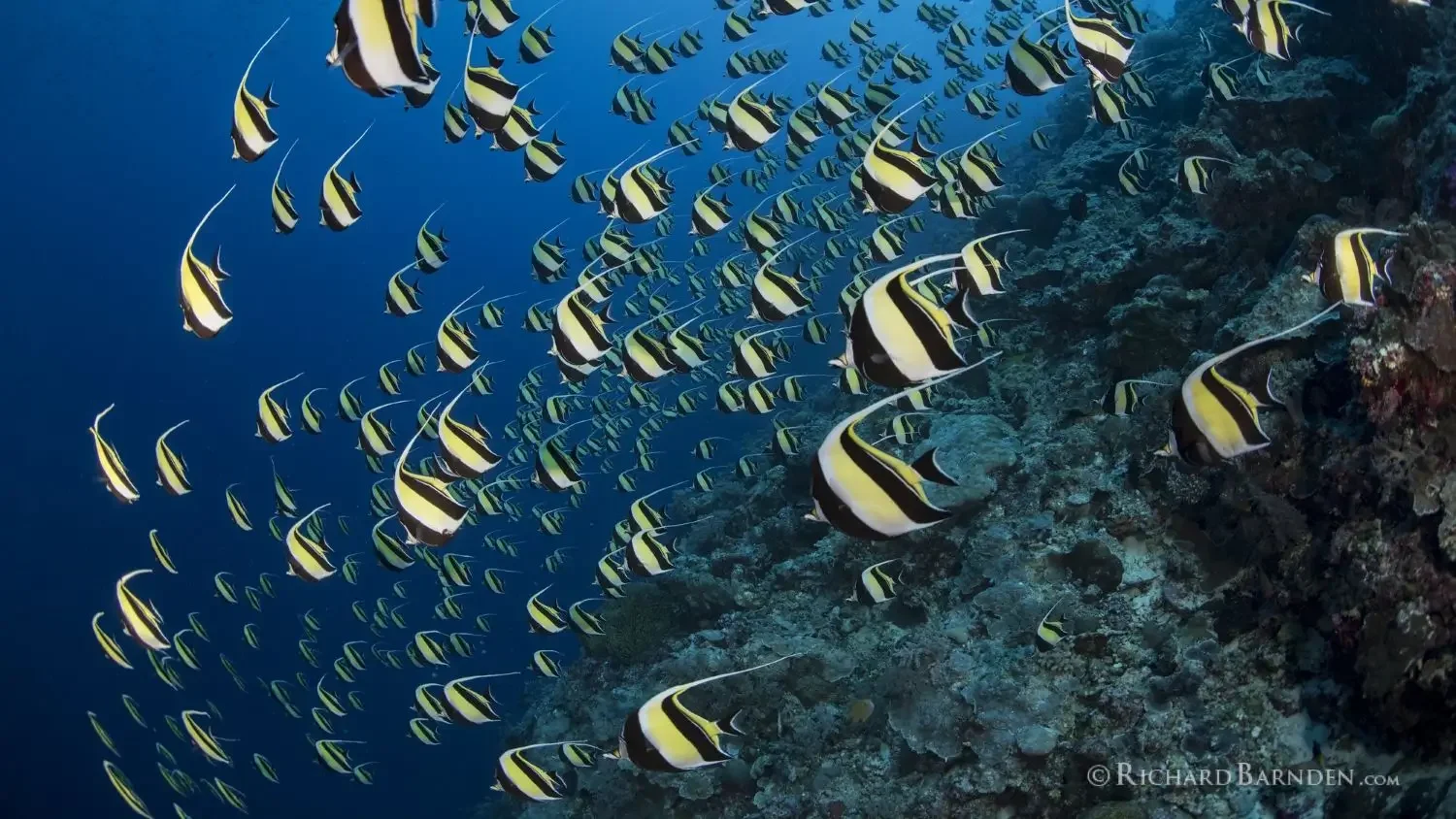
Moorish Idols gathering together on the reef. Photo: Richard Barnden
Day Five was always going to be special. The plan called for the southern tip of Peleliu, an area with some of the most exposed and current-swept diving in Palau. These are the kind of conditions that concentrate sharks, and The Cut delivered exactly that: a strong current, reef hooks deployed, and then the wait. Fifty sharks. And a devil ray, appearing from nowhere, making a single commanding pass before vanishing back into the blue.
After a brief stop ashore on the island, we moved to Orange Beach for a complete change of pace. It’s not too often you get to dive an exquisitely beautiful coral reef threaded through with the remnants of World War Two. It’s a reminder that Palau's history is as layered as its marine life, and provided the kind of reflective dive that earns its place in a schedule dominated by big animal encounters.
Then we returned to the Siren, ate lunch, rested, and went back to Blue Corner. What happened next is the reason I am writing this report.
The current was good. We dropped in and made our way to the very tip of the dive site… and there they were. Not twenty Moorish Idols. Not fifty. Approximately seven hundred Moorish Idols covering the reef, moving as a single organism, swimming around and between the divers as if we were simply part of the scenery. The group scattered across the reef, taking photos and videos, watching in near-silence.
And then the Moorish Idols left the reef. They moved off into the blue water unprompted, with one theory suggesting they were spawning. But we didn’t see that… because the sharks arrived.
Hundreds of grey reef sharks, rising from below and from the walls, chasing the Moorish Idols toward the surface in a frenzied, coordinated hunt. We watched from below as the scene played out above us: the idols scattering, the sharks pursuing, and then an enormous school of small tuna arriving to investigate the commotion, circling the entire spectacle from the edges.
The guides later told us this was an event so rare that even dedicated underwater documentary crews have not managed to film it. We surfaced to cheers loud enough to carry across the water.
Sharks cruising off the reef in large numbers around the spawning at Blue Corner in Palau. Video: Luke Coley
Day 6: Blue Corner Again — And Again
After an evening spent processing what we had witnessed, we returned to Blue Corner the following morning to see what remained. A good number of Moorish Idols were still on the reef; the survivors, regrouping. The current had swung to a mild outgoing flow, but there were still forty to fifty sharks working the area, and a hammerhead in the hook zone.
We adjusted the afternoon plan and headed to New Drop Off for a relaxed wall, simply to give everyone a break from the intensity, before filling the skiffs with tanks for a final double-header at Blue Corner. The idols were still aggregating, and with them came the sharks: a hundred to two hundred grey reefs schooling across the site, patrolling the reef and massing in the blue. On the fourth dive of the day, we were completely alone at one of the world's most famous dive sites, surrounded by a wall of sharks.
That evening, as we navigated back toward Ulong, the guides gave the briefing for the following morning's Bohar Snapper spawning. After everything we had already seen, it felt almost surreal to be told the main event was still to come.
Day 7: Shark City and the Snapper Spawn
We rose before sunrise. The plan was Shark City, a deeper site on the outer reef, timed to coincide with the dawn spawning aggregation of Lutjanus bohar — the Bohar Snapper.
We checked the current; it was mild, and dropped in… to six or seven thousand snappers, moving together in the water column, performing their ritual dance in the early light before pushing off into the blue to spawn. And hunting them, patient and purposeful: four bull sharks, two oceanic blacktip sharks, and, spotted by one of the guides, a tiger shark working the edges of the aggregation. These were moments of extraordinary biological theatre.
We ended the dive hovering in the blue, watching the action unfold around us, and surfaced to cheers. Later that morning, at Siaes Corner, another surprise: the skiff captain spotted that Moorish Idols had aggregated there too, and the corner was alive with another hundred to two hundred grey reef sharks doing exactly what they had done at Blue Corner days earlier; staging, patrolling, hunting.
The afternoon was a welcome exhale. A lazy few hours aboard, and then the black water briefing before the black water night dive; dropping into open ocean darkness, following the lights at fifteen metres, watching the nightly migration of deep-water creatures toward the surface. Long-tentacled octopus, transparent larvae, and bioluminescent organisms… an entirely different ocean.
Day 8: A Second Spawning — And a Different Kind of Magic
The weather was beginning to ease toward the scattered showers and light winds that are normal for Palau, but it changed nothing about the diving. Day Eight meant a second Bohar Snapper spawning, and it was notably different from the first. There were no sharks visible in the water, but the spawning itself was on another level. The mass of fish, the movement, the biological intensity of it. For some guests, quietly and without any drama, this became their favourite dive of the entire trip.
Siaes Corner for Dive Two was busier than ideal at the start, sometimes that is simply how it goes at a site this popular, but we waited, and patience was rewarded when a school of over a hundred sharks materialised and stayed with us through the second half of the dive.
For the final dive of the day, we opted for Long Wall: a shallower, calmer site, with beautiful coral gardens, and around twenty juvenile reef sharks schooling in the clear water. After the scale and intensity of everything that had come before, it was exactly what we needed.
Group member Liz celebrating dive 600. Photo: Luke Coley
Day 9: Three New Sites — Tunnels, Wrecks, and Critters
The final day of diving took us to three sites that none of us had visited on this trip. First, Siaes Tunnel, a deeper dive through a cathedral-like passage that felt genuinely otherworldly after a week of reef and blue water. Then the Iro, a Japanese supply ship over 400 feet long sent to the bottom by a torpedo during World War Two, and now encrusted and teeming with life on every surface. And finally, the Haf Adai wreck for the macro lovers in the group; nudibranchs, critters, the small and intricate world that exists alongside all the grand spectacles.
It was a fitting final day. Three completely different experiences, all of them world-class, all of them reminders that Palau does not need the spawning events to be extraordinary. They just make it incomparable.
Final Thoughts
I have been lucky enough to spend years diving and photographing what I see, and I choose the trips I take carefully. This spawning expedition is the single most biologically concentrated diving experience I have ever had. Not just in terms of the rare events, the seven hundred Moorish Idols, the spawning hunts, the Bohar aggregations, but in the quality of the diving that surrounds them. The team, the routing, the vessel, the guides: everything is designed to put you in exactly the right place at exactly the right moment.
A very happy Pixel Expeditions group with a very happy Palau Siren crew.
The chances of hitting all this action are tied to the full moon in January and February. If you are a serious diver, a wildlife photographer, or simply someone who wants to witness something that the ocean rarely shows the world, this could well be the trip.
I cannot wait to go back.
Frequently Asked Questions
When does the Palau Siren Moorish Idols Spawning Expedition run?
The expedition is only possible a maximum of twice a year, timed to the full moon in January and February. The itinerary is specifically built around the lunar cycle that triggers the Moorish Idol and Bohar Snapper spawning aggregations, so the dates are non-negotiable. Spaces are limited to 16 divers, so early booking is strongly advised.
What experience level do I need for this expedition?
Most of the diving is suitable for experienced recreational divers comfortable with currents. Several key sites, including Blue Corner, Siaes Corner and The Cut, require the use of a reef hook, and you should be comfortable diving in strong currents. The Bohar Snapper spawning dives are classed as advanced dives only, as they take place at depth in open water at first light. A minimum of 50 logged dives and prior current diving experience is recommended.
Is a reef hook essential, and will I be provided with one?
A reef hook is absolutely essential for this expedition; without one, you will miss the best of Blue Corner, Siaes Corner, and the spawning action at several key sites. It is worth bringing your own if you have one, though you may be able to purchase one onboard. Using a reef hook correctly, without damaging coral, is a skill worth practising before you arrive.
How likely am I to actually see the Moorish Idol spawning event?
Witnessing the full spawning event, where the aggregation leaves the reef and triggers a shark hunt, is genuinely rare. Even professional documentary crews have not managed to film it. What the expedition does reliably deliver, thanks to Richard Barnden's two decades of experience timing these dates, is the aggregation itself: large schools of Moorish Idols building on the reef, accompanied by hundreds of grey reef sharks. The full spawning event, as we experienced it on Day 5, is the exception rather than the rule, which makes it all the more extraordinary when it happens.
What wetsuits and gear should I pack?
Palau's water temperature typically ranges between 27–30°C (81–86°F), making a 3mm wetsuit comfortable for most divers. However, during January and February, cold thermoclines can push temperatures down to 23–26°C (65–70°F) at depth, so a 5mm is worth packing as a backup. Wide-angle photography setups will get the most use on this expedition, given the big animal encounters, though macro opportunities exist too, particularly on the wreck dives.
How many dives per day do you typically do in Palau?
Most days involve three to four dives, including some sunset dives and at least one blackwater night dive during the expedition. The Bohar Snapper spawning dives are early morning dives timed to sunrise. The pace is intensive by liveaboard standards, which is exactly what the guests on this expedition come for, but Palau Siren's comfortable cabins and well-organised dive deck make recovery between dives straightforward.
Can I join this expedition as a solo traveller?
Absolutely. The expedition format naturally brings together a small group of like-minded divers, a maximum of 16 guests, and solo travellers are very well catered for. Several guests on our trip came alone and found the pre-trip days on land particularly valuable for getting to know the group before boarding. It is worth contacting Pixel Expeditions directly about cabin-sharing options if you are travelling solo.